

Published November 8, 2026
NEWPORT BEACH | CITY HALL WATCH | NOVEMBER 8, 2026
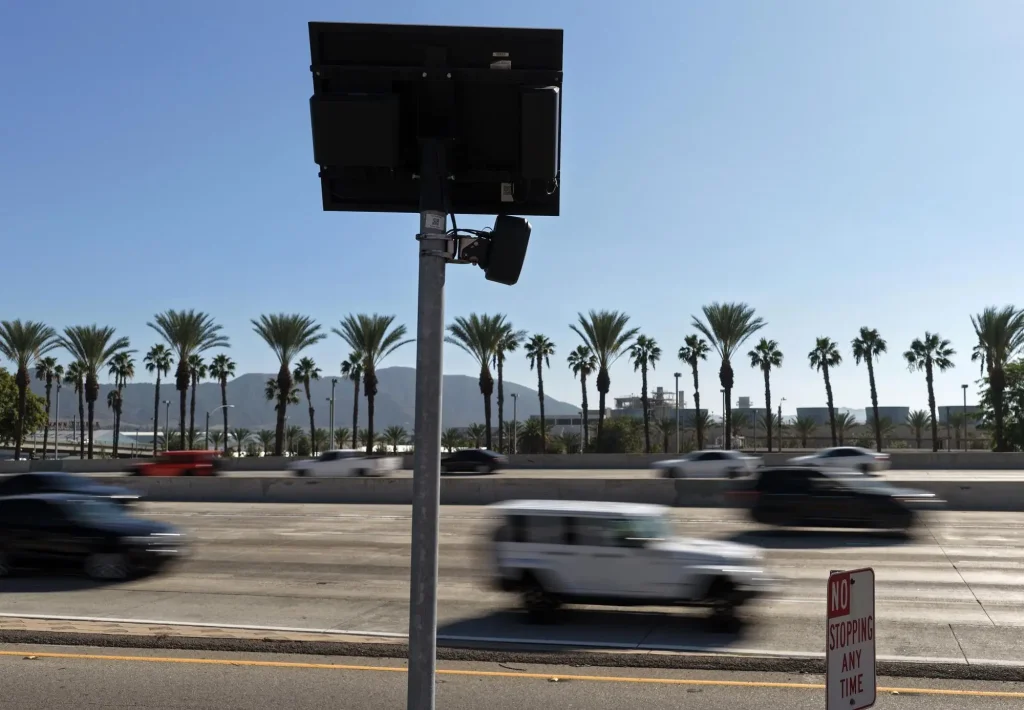
Drive into Newport and there’s a decent chance a camera on a pole wrote down your license plate. Not a speed camera. A Flock automated license plate reader, and the city has a lot of them.
Newport Beach Police Department now publicly posts an Automated License Plate Readers policy that spells out authorized uses, access restrictions, monitoring, retention and data-sharing provisions.
How we got here
On July 9, 2024, the council approved a contract with Flock Group of Atlanta for 69 readers “strategically placed throughout the city,” keeping data for 30 days. A first amendment added four around Fashion Island, for 73. In September 2025 the council approved four more: dual cameras at the Corona del Mar State Beach entrance and two along Newport Coast Drive. That’s 77. Police updates to the Civil Service Board this year mention three more planned for Bayview Heights.
The same September 2025 amendment stretched how long the data is kept, from 30 days to one year. Police said a month wasn’t long enough because crimes often get reported late and patterns take time to connect. The contract now tops out at $1,618,100.
Some neighborhoods aren’t waiting for the city. One homeowners association reviewed a $22,000 proposal to put up Flock cameras of its own.
The questions
Nobody’s saying the cameras don’t help catch bad guys. But a year of everybody’s comings and goings is a lot of data, and locals should know how it’s handled.
- Where are they? We couldn’t find a public map. Are any on the peninsula?
- Who can search the data, and for what? California law requires agencies running these readers to post a written usage and privacy policy. Newport’s policy is now posted publicly. It says ALPR data is for official law-enforcement business; access is limited to trained employees with a legitimate law-enforcement need; and searches must be logged with the user’s name, date, time, case or incident number and reason. The policy also calls for a monthly audit of ALPR inquiries.
- Who else sees it? The policy says ALPR data may be shared with other law-enforcement or prosecutorial agencies for official law-enforcement purposes, or as otherwise permitted by law.
There is an important difference between the contract and the posted policy. The Flock contract amendment calls for retention of up to one year. The department’s policy says ALPR data should be stored for at least 30 days and then automatically deleted unless it has become, or is reasonably expected to become, evidence or is subject to a discovery request or other lawful demand.
The public can now read the rules. The remaining question is how the one-year contract retention period fits with the department’s posted 30-day default.
Sources
- Staff report: Amendment No. Two with Flock Group, Sept. 9, 2025
- Civil Service Board minutes (police update on Bayview Heights readers)
- Parks, Beaches & Recreation packet referencing an HOA Flock proposal
- California Civil Code 1798.90.51 (ALPR usage and privacy policy)
- Newport Beach Police Department Automated License Plate Readers policy
This story is checked every 3 days for its first 30 days. When there’s news, we add a dated update here. How we keep stories current →
Help us out, Newport.
Read next
 City Hall WatchSave Balboa Village: 5 Small Business Ideas for Newport Beach City HallFrom the Balboa Island Ferry to 15th Street Surf Shop, Newport's legends are small businesses. Balboa Village is hurting, and City Hall is still "considering" how to help. Here are…Read story →Suggestion 1 of 5
 City Hall WatchNewport Beach Shipped Real Sand to Four Empty New York Storefronts. Balboa Has Empty Storefronts Too.Visit Newport Beach turned four vacant Manhattan storefronts into a Newport vacation, real sand and all. Back home, Balboa Village has empty storefronts of its own.Read story →Suggestion 2 of 5
 City Hall WatchNewport Beach Rehired Stapleton, Weigand and Kleiman. Balboa’s To-Do List Is Still on the Counter.Same council, four more years. Here's what's still waiting on the Balboa Peninsula, from P, Q and R to $27.4 million.Read story →Suggestion 3 of 5
 Around NewportNewport-Mesa High School Students Can Take College Classes for Free This SpringHere's something Newport families might actually want to get ahead of: local high school students can take college classes this spring without paying tuition.Read story →Suggestion 4 of 5
 Surf & CoastWest Newport Is Getting $1.5 Million in Trucked-In Sand. The 62nd Street Groin Is Still a 1974 IOU.City Hall voted 5-0 to haul river sand into West Newport. The groin it planned at 62nd Street back in 1974 is still missing.Read story →Suggestion 5 of 5